Stone guide · diopside, chrome variety
Chrome diopside
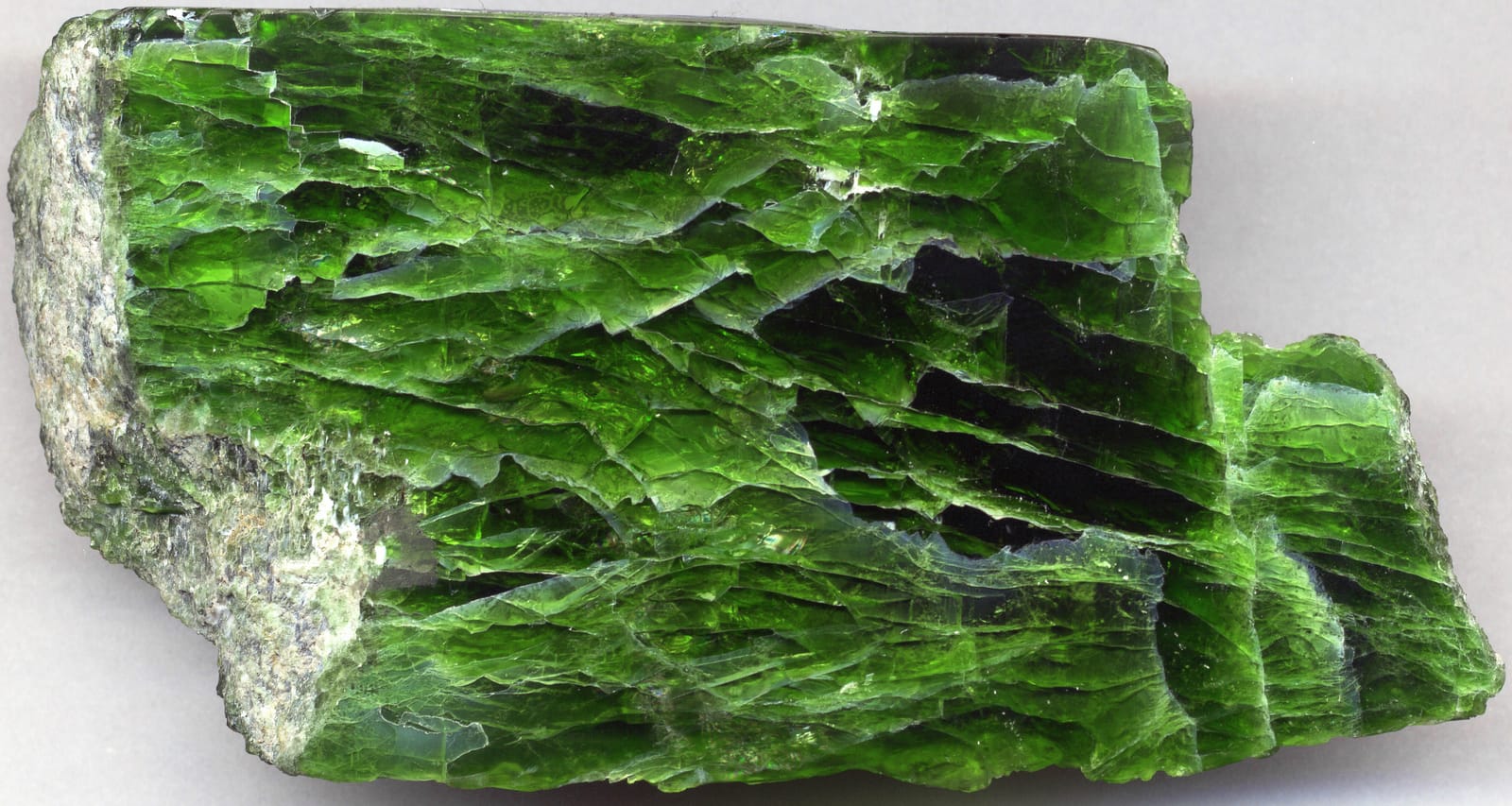
Deep green diopside colored by chromium. Main source is the Inagli massif in Yakutia (Sakha Republic), Russia. Usually untreated; soft for a ring stone.
Updated · Facts from 10 named sources, listed below
Durability
5–6 (Mohs)
earrings and pendants preferred; rings need protective settings
Treatments
usually untreated; no routine treatment is known
Main source
Inagli massif, north of Aldan, Russia
Main commercial source; in the jewelry trade since 1988; mined in summer only
Typical size
most cut stones 0.5 to 2 ct; stones over 3 to 4 ct are rare
Price per carat
Price collection starts soon. The tracker will show sellers' asking prices per carat by size band, from named shops, updated daily. We publish no sample or estimated prices.
Properties
| Property | Value | Sources |
|---|---|---|
| Hardness | 5–6 (Mohs) | [6][8] |
| Cleavage | good to perfect | [6][8] |
| Best jewelry use | earrings and pendants preferred; rings need protective settings | [4][7] |
| Color | medium to very dark green; stones over about 3 ct often look very dark, almost black | [3][4] |
| Cause of color | chromium (Inagli stones: 0.13 to 0.75 wt% Cr2O3) | [3][9] |
| Treatments | usually untreated; no routine treatment is known | [1][5] |
| Typical size | most cut stones 0.5 to 2 ct; stones over 3 to 4 ct are rare | [1][5] |
| Refractive index | 1.668–1.726 | [8][6] |
| Birefringence | 0.024–0.030 | [8][5] |
| Optic character | biaxial positive | [5][8] |
| Specific gravity | 3.17–3.40 | [5][8] |
| Luster | vitreous | [2][8] |
| Crystal system | monoclinic | [10] |
| Chemical formula | CaMgSi2O6 (with Cr) | [10] |
Where sources disagree, we show the widest range they give.
Where it is mined
- Russia · Inagli massif, north of Aldan, Sakha Republic (Yakutia)Main source
Main commercial source; in the jewelry trade since 1988; mined in summer only
- PakistanProducing
Additional source
- AfghanistanReported, not confirmed
Listed by GIA as a deposit; no production detail
- Finland · OutokumpuReported, not confirmed
Listed by GIA as a deposit; no production detail
- MyanmarReported, not confirmed
Listed by GIA as a deposit; no production detail
"Reported, not confirmed": named in the literature as a minor source; we have not confirmed current production.
Lookalikes and how to tell them apart
These are the stones most often confused with chrome diopside. Most of the tests need a gemologist's instruments. A photo alone cannot settle them; see screening, not appraisal.
-
Chrome tourmaline
Natural stoneRI about 1.62-1.64, birefringence about 0.020, harder (7-7.5).
-
Demantoid garnet
Natural stoneSingly refractive, RI 1.881-1.888, strong fire; horsetail inclusions are typical but not proof on their own.
-
Emerald
Natural stoneLower RI about 1.57-1.60 with little doubling, harder (7.5-8), almost always oiled; inclusions often visible to the eye. Both can look red under a Chelsea filter, so the filter does not separate them.
-
Peridot
Natural stoneMore yellow-green, RI about 1.65-1.69 with strong doubling, lily-pad inclusions.
-
Tsavorite garnet
Natural stoneSingly refractive (no doubling), higher RI 1.735-1.744, harder (7-7.5).
-
Synthetic spinel or YAG (green)
SyntheticSingly refractive; YAG has high RI about 1.83; sold as cheap "simulated" stones.
-
Green glass
ImitationSingly refractive, gas bubbles and swirl marks, warm to touch, RI usually about 1.5.
Sources
- GIA: Tao Hsu and Andrew Lucas, "The Great Potential of Diopside in the China Market" (June 19, 2015)
- GIA Gem Database: Chrome diopside, Gübelin Collection no. 35385
- Smithsonian National Museum of Natural History: Chrome diopside, Geogallery
- AGTA: Chrome diopside
- International Gem Society: Diopside jewelry and gemstone information
- International Gem Society: Chrome diopside faceting information
- International Gem Society: Green gemstones
- GemDat: Chrome-Diopside
- Geochemistry International: Naumov et al., vol. 46, no. 6 (2008), abstract
- SkyJems encyclopedia: Chrome diopside (gem dealer)
Checked November 20, 2026. Facts are summarized from these sources; they can disagree, and dealers' pages may favor what they sell. Spotted an error? Tell us via the About page.